 |
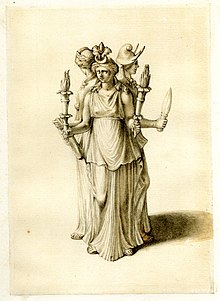
| Hekate, Three Headed Goddess of the Crossroads. |
Another thing was when we did the exercise listing
Olympian and chthonian gods I didn’t even think of putting any of the good
which I think of as the big 12 in the chthonian list. To me the big 12 are like
the superior gods who ‘deserve’ to live on mount Olympus because of how
powerful they are rather than the type of power they have and so chthonian
deities are inferior and lacking in power. Or another way I think I think of it
is as a very Christianised binary of simply good vs. evil...
My list of chthonian deities included:
- Hades
- Persephone
- Gaia
- Rhea
- Prometheus
- Hecate
- Nyx
- Zeus katachthonians (added during discussion)
But when we did discuss deities started to move but
only in an Olympian to chthonian fashion. It seemed like the Olympians often
had different sides to them but the chthonian were stuck in their places.
I’ve started to think about Greek religion through
the concept of Christianity as I have to started to realise that I have quite a
Christianised view of the world even though I would say I wasn’t a religious
person. I’m more agnostic and haven’t had a strong Christian upbringing really.
My main thoughts when thinking of the chthonian is that they were the ‘evil’
deities but that idea can’t have been there in ancient Greece? Surely it’s only
my view of the world. The evil feeling grew stronger as Susan was telling us
about how serpents were seen as chthonic because they were close to the ground
and shed their skin, which is in keeping with the idea of life after death, but
all I could think about was Adam and Eve and the serpent and once again the
concept of evil was right in the front of my mind.
But where does the notion of evil really come from and
can we say the Greeks had a concept of it? The gods themselves didn’t really
seem to have any concept of morals. They are petty and the stories are full of
parricide and incest – things which were a real taboo in Greek society. So
could we maybe say the gods were there as beings one shouldn’t emulate, a guide
in how not to act maybe? But were they evil? I wouldn’t say they were.
The deity I consider to be a classic chthonian is
Hekate, maybe because I got introduced to her quite recently but she was never
in my head as one of the ‘big 12’ Olympians and so her identity isn’t confused.
According to Larson her role was to protect those travelling from dangerous
spirits since she could control the restless dead (Larson 1997:166). She eventually became the ‘mistress
of the crossroads’ and her name ‘Hekate Chthonia’ started to be used on lead
curse tablets about the fourth century B.C.E. As she guarded the crossroads it
meant she also guarded the graves along the roadside which was her link to the
dead (Price and Kearns 2003:243). In this way and the fact she was the goddess of
witchcraft, as seen in Medea, seems to link once again to Christianity and the
persecution of witches – Salem witch trials for example for having powers beyond
mortal means, not forgetting that she was also crowned with serpents and oak
leaves. The serpent idea links back to the idea of original sin and the devil. So
although she might have been seen as ‘evil’ in the moral sense she was “seen as
simultaneously terrible and benign” (Price and Kearns 2003:243).
I like Hekate quite a lot
actually. She seems to be an interesting figure, benign or evil. Maybe I should
have concentrated on her, it is a shame I discovered the intricacies of her
character so late in my blogging experience. It is too late to change now but
maybe I can study her more in further studies.
Bibliography
- Larson, Jennifer (2007) Ancient Greek Cults: A guide. Routledge. London & New York.
- Parker, Robert (2011) On Greek Religion. Cornwell University Press. Ithaca.
- Price, Simon and Kearns, Emily, eds. (2003) The Oxford Dictionary of Classical Myth & Religion. Oxford University Press. Oxford.
Image
- http://upload.wikimedia.org/wikipedia/commons/thumb/2/2e/AN00969955_001_l.jpg/220px-AN00969955_001_l.jpg

No comments:
Post a Comment