Monday, 25 March 2013

I Discuss my 'Vehicle' for my Blog.

Who will my 'Vehicle' be?


This blog will accompany a module called Ancient Greek Religion which I’m studying in my third year at the University of Roehampton and I will use it to reflect on what I have learned throughout the module.

In the introductory lecture Susan suggested that for our blogs we should choose a figure or an aspect of religion which we can use as a vehicle to think further on the subjects we will discuss each week. I want to choose a figure but no one currently springs to mind though I can rule many out. As I’m in my third year I don’t really want to take an easy option of looking at a deity I have studied before. So Heracles is out, and Aphrodite who I’m looking at sort of in my dissertation in her role of Venus in 18th century statuary. And yes it’s a little different to what this course is all about but we can have too much of Aphrodite sometimes and she is one of the most prolific ones. So she’s out and Athena by the same token. And Zeus, who wants to use the king of the gods! How predictable and boring! Well, you know what I mean. Dionysus I have touched on briefly in first year Greek Literature and Second year Gender and Sexuality (I think, maybe) so he’s gone. Artemis has always been quite interesting to me too but I think I would like to look at someone away from the big 12 Olympians that everyone knows. So hmmmm… who to pick off the top of my head right now (I might have to do a little research but I’m not running off to Google yet). Thinking, thinking.

Well in class we did discuss Hecate who I came across at the beginning of the week in my dissertation research – the willow tree was sacred to her and so if found in gardens it could mean the garden was dedicated to her (McIntosh 2005:3). I’m largely unaware of her but a goddess of darkness and witchcraft always sounds like a cool person to look at, right? The other sort of figure I would like to look at in more in depth would be a personification. I have looked a little at Peitho before who has popped up in various times while I was researching Aphrodite. Or maybe … Ok, nothing else is coming to me. To Google!

Well after a little search through www.theoi.com, a wonderful little website that has currently saturated my brain somewhat with lots of information on the vast subject of Greek mythology, I have discovered the goddess Nyx (night). She is the mother of quite a few deities including Thanatos (non-violent death), Hypnos (sleep), Eris (strife) and Nemesis (retribution) but actually I haven’t really heard or thought about her before so she is a new and interesting character for me to look at. We’ll see what happens next week and how I’m going to structure this blog but I think I would like to use Nyx. Or maybe I’ll just run away to an easy life and use one of the big 12. I hope not. 

Bibliography

  • ·         McIntosh, C. (2005) Gardens of the Gods: Myth, Magic and Meaning. I.B. Tauris & Co Ltd. London.


Image

  • http://images3.wikia.nocookie.net/__cb20120714155936/community-sitcom/images/thumb/a/af/Question_mark.png/380px-Question_mark.png

Tackling Greek Religion.


These pictures reflect natural disasters that could be mistaken
for acts of the gods.
Top: Tsunami reflecting the power of Poseidon.
Bottom Left: A drought, perhaps caused by enraging a fertility
goddess like Persephone.
Bottom Right: Lightning, Zeus's true form perhaps?
Right well, previous commitments, laziness and time constraints mean that I can’t quite do this posting straight away although I am writing straight after the lecture again. Unfortunately, unlike last week I do not really have any ideas in my head.

I found the lecture quite interesting and it wasn’t till the very end that it really did make me think about religion and if the Greeks had it. When the question was posed on the board I immediately went yeah, of course. What are the reasons why they didn’t? The question confused me because it seemed obvious but I suppose by thinking about defining religion maybe they didn’t. I really liked what Susan said about how maybe they had religion but not a religion (Explain). It can’t really be separated unlike religions today. It was also pointed out that they didn’t have a word for religion, only ‘θρησκεία’ which Perseus translates as ‘religious worship, cult and ritual’. The Oxford English Dictionary defines religion as “the belief in and worship of a superhuman controlling power, especially a personal God or gods”. So the obvious difference here seems to be a difference between passive and active participation. Whereas religion is merely belief, ‘Thriskeia’ is active participation in the worship of that belief. Another interesting point for me was that religion is a choice for many of us now but then it wasn’t questioned at all. It was just what you did. Perhaps it was because of aetiological reasons. If you don’t know how the world was made but there are stories claiming that higher, more powerful beings than yourselves created the earth wouldn’t the easiest, simplest and the most obvious course of action simply be to worship and appease them? The gods in Greek myth are horrible and vindictive and so out of fear you would try and placate them.

For example, in the Homeric hymn to Athena when she appears out of Zeus’s head
“Mighty Olympus went reeling
 Dreadfully under the impact of grey-eyed Athena, and round it
 Earth gave a horrible groan, and the depths of the sea were excited,
Seething with purplish waves, and the salt water swell was suspended.”
(Hymn 28. 11-13)

Even Zeus, the contested king of the gods, was relieved when she took off her armour.
Examples of the vindictiveness of the gods can be found in many places – the story of Artemis and Actaeon where he comes across her bathing and she turns him into a stag and his dogs kill him in a frenzy as told in Callimachus’ Hymn 5. In Euripides’ Hippolytus, Aphrodite takes revenge on Hippolytus for worshipping Artemis alone while snubbing Aphrodite, which ends in his tragic death.

Zaidman suggests that when looking at Greek religion we need “cultural estrangement”, a separation of our own preconceptions and ideas of what ‘religion’ entails. Whenever I think of religion I know that I am thinking of it through Christian eyes because that’s all I know, even though I wouldn’t identify as a Christian myself. And that is another odd thing. Religion is a choice for most of us, or is it? My mother was brought up in a very Catholic setting where she was just expected to believe what she taught and even as an adult she felt pressured into having me christened even though she no longer believed anymore. So is religion about belief? It can just be a part of someone’s life so even though they don’t really believe wholeheartedly, they will still follow rituals because it is expected of them.


Bibliography.

Images.
  • http://wallpapers.free-review.net/12__Lightning.htm
  • http://edgecast.metatube-files.buscafs.com/uploads/gallery/pics/gallery_pic_1612_19391.jpg
  • http://news.bbcimg.co.uk/media/images/54152000/jpg/_54152151_jex_1112383_de14-1.jpg


I have been coming to suspect that Christianity is a closeted polytheistic religion.

Constantine with a Standard Depicting the Holy Trinity. 
After our lecture on polytheism I have gone away and drafted a post but I wasn’t too sure where to go with it, however something happened today that has given me a bit of direction and has got me thinking further on polytheistic religions. I was at waiting a bus stop wasting time, by looking at the map of the area and a couple of places caught my eye. In Putney there happens to be a school called ‘Our Lady of Victories Primary School’ and a church called ‘Our Lady of Pity and St. Simon Stock’ and I know that there’s also a school in Staines called ‘Our Lady of the Rosary’ and Notre Dame Cathedral  in Paris means ‘Our Lady’ too and after asking my Mother, a relapsed Catholic, she confirmed that these are all names for the Virgin Mary and it just struck me how similar it is to the different epithets and aspects various deities had within ancient Greek religion.

The Oxford English Dictionary’s definition of monotheism is “The doctrine or belief that there is only one God (as opposed to many, as in polytheism).” So I suppose that on the basis that Mary and the saints are mortal and not seen as Gods then the statement that Christianity is polytheistic is categorically wrong, but I was struck with how similar the Virgin Mary, with her different aspects and epithets, is to the multi-faceted personalities of goddesses like Athena.

When I googled ‘Is Christianity a Polythesistic religion?’ I find I am not the only one who has thought of this before. However the main problem the people of the internet have come up against is how the Holy Trinity, made up of the Father, the Son and the Holy Ghost, can be one and three at the same time and STILL be monotheistic which was something I hadn’t even thought of since my route in was Mary. Some of the answers are given are pretty standard for the internet with no real thought behind them other than ‘my view is right and everyone else’s is wrong’ but others do have clearer reasoning.

While I understand the basic thought is that Christians only worship one being and Mary or the saints aren’t being worshipped in the same way, therefore they are not gods and therefore the religion is not polytheistic, I still feel that the properties of Mary are very similar to Athena. At face value they are both virgin goddesses but also mothers: through Erechthonious and Jesus Christ and they are both linked to the spirit of the Father: Athena through being born out of hers and Mary through her immaculate conception.

Parker says that the epithet system doesn’t make the god a different being from the god with the single name “Athena Hippia, of horses, is one aspect of Athena seen in close-up, not the expression of a different conception of the deity.” (Parker 2007:67) So in the same way Mary with her many epithets is still the same person, even though she is in so many places around the world due to her appearances to different Saints.

While I understand that for reasons of its own Christianity clings on to its monotheistic status, but even ignoring the Holy Trinity conundrum, other aspects of the faith are very close to aspects of Greek Religion. But if it wants to stay in the closet for a little while longer we won’t say anything. It will be our little secret.


Bibliography
Image

  • Rome: The Rise and Fall of an Empire. 2006. Episode 5. BBC One

Anthropomorphism


Reconstruction of Athena Polias, from
Museumparj Orientalis, Mjmegen, Holland.
In our discussion of Anthropomorphism in class we talked about gods being depicted as humans but also how cult statues of the gods were often personified. Parker notes how the sources talk of the goddess Athena herself and not just her image being taken to bathe in certain rituals (Parker 2011:185) and these are the rituals which I want to focus on in this post. In Plutarch’s Alcibiades 34 he talks of the Plynteria festival at Athens. The name comes from the verb ‘to wash’ and refers to the ritual of undressing the statue of Athena Polias and then washed by being taken to the sea in a procession by the women of the genos Praxiergidai (Price and Kearns 2003:437). During that time the temple is closed off for the day and was seen as impure for the protector of the city was absent for a time due to the veiling of the statue once the clothes were removed. Plutarch says “the Athenians regard this day as the unluckiest of all days for business of any sort.” (Plut. Alc. 34.1) So when Alcibiades returned that day it was considered a very ill omen which shows how much power the Greeks gave to inanimate objects and how different to our religion today.

But again, as I’m sure you can see where I’m going, I’ve been thinking, maybe dangerously, of Christian parallels which show that the Greeks weren’t too far away from us and how Christianity was influenced by the religions around it. So I have once again been looking at parallels between Mary and Athena. Mary acted as a mediator between the divine and earthly realms due to the belief of her ascension into heaven. A particular place where the cult of Mary took hold is Constantinople as a result of relics that has been collected there, such as “her robe, girdle, shroud and the swaddling clothes in which Christ rested against her breast” (Coleman 2006/7:397). These became important relics to the city and achieved more and more attention in ceremonies so in 626 C.E a procession was made around the walls with an icon of Mary to help defend them against attack (Ibid 397). Indeed a cult statue to Mary is still paraded round Rome today as part of the May devotions.

It can be seen that both these protective deities hold great cultural and political power within their own cities, indeed Plutarch tells us that Alcibiades guards the procession of Athena Polias with his own cavalry to make up for the bad luck surrounding his return to the city on that exact day (Plu. Alc.34). Therefore once again I see the links surrounding the two religions, though I will have to admit that this one is more contrived than the others were and is not quite part of my upbringing but as a result of my interest in this topic. Maybe I’m just falling into the trap of seeing what I want to see. 


Bibliography
  •          Coleman, Simon. “Mary: Images and Objects.” In Beattie, Tina and Boss, Sarah Jane. Eds. Mary: The Complete Resource. Continuum International Publishing. London.
  •          Parker, Robert (2011) On Greek Religion. Cornwell University Press. Ithaca.
  •          Plutarch. Translated by Perrin, Bernadotte. (1916) Plutarch Lives. William Heinemann Ltd. London. (http://www.perseus.tufts.edu/hopper/text?doc=Perseus%3Atext%3A2008.01.0006%3Achapter%3D34%3Asection%3D1 Last accessed 25th March 2013)
  •          Price, Simon and Kearns, Emily, eds. (2003) The Oxford Dictionary of Classical Myth & Religion. Oxford University Press. Oxford.


    Image
    ·         http://travelingclassroom.org/?p=290


Reflection on my Christian ‘Goggles.’

What I wish Christian goggles REALLY looked like. 
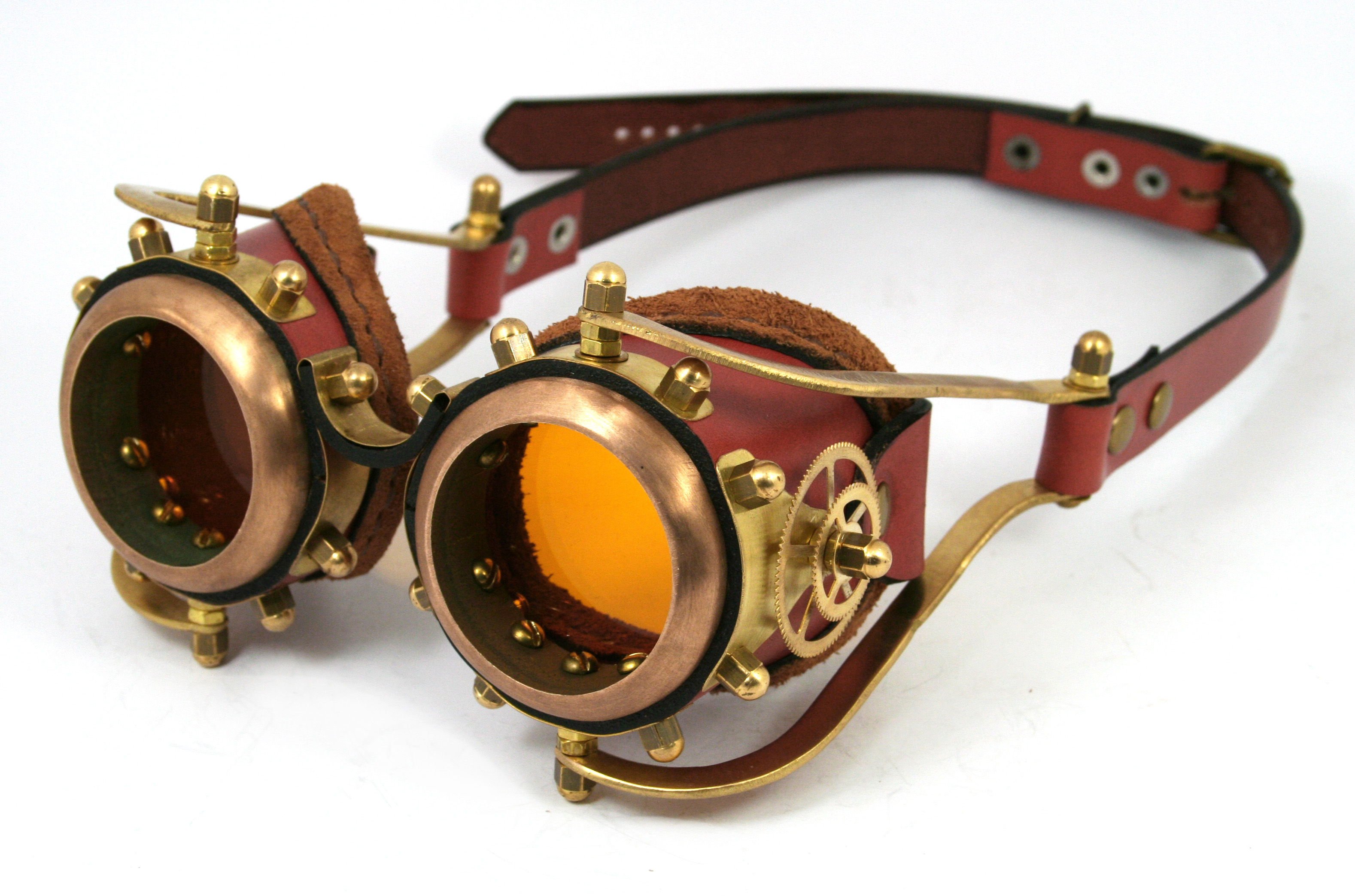
Well I have come to realise that as I’ve been writing these posts instead of removing my ‘Christian goggles’ and putting my culture behind me I have embraced them whole heartedly and have been looking at the similarities of Greek religion to the one I know, albeit not intimately. I’m not sure how much I should be doing this or if I am just following the follies of 19th century classists who muddied the waters between the two religions and therefore taking a rather anachronistic view to the whole affair.

My friend recently bought a book for this course which turned out to have been written in 1864 and so is the perfect example of 19th century views. The book is The Ancient City by Numa Denis Fustel de Coulanges, a French Historian. In his introduction he identifies and stresses the need for ‘cultural estrangement’ for he says that “having imperfectly observed the institutions of the ancient city, men have dreamed of reviving them among us” (Fustel de Coulanges 1864:11) and so to remedy this imperfect view of ancient society he suggests that “it is wise to study them without thinking of ourselves ... with the same disinterestedness and with the mind as free, as if we were studying ancient India or Arabia” (Ibid 11-12). So he seems to be on the same page and advocating the same approach as Bruit Zaidman and Schmitt Pantel in their book about 200 years later. They say that the study of Greek religion was done for the purpose of discovering how a monotheistic faith like Christianity was influenced but “the effect of this interpretation is to refract Greek religion artificially through the distorting prism of Christianity” (Bruit Zaidman and Schmitt Pantel 1989:4) and that’s what Fustel de Coulanges seems to have done without even realising it.

After suggesting one shouldn’t think of themselves his obvious Christian background still shines through without him even realising it. When talking about the physical nature of gods his default position is to talk of the Judeo-Christian god with complete confidence in His existence. “He [man] knew not that the earth, the sun, and the stars are parts of one same body; the thought did not occur to him that they might all be ruled by the same being” (Fustel de Coulanges 1864:121). The thought does not seem to occur to Fustel de Coulanges that this same being could not exist. Well maybe that is my inherent scepticism shining through but I say that is simply a part of my upbringing and the society I live in. No matter how hard one tries your upbringing will just shine through.

So while thinking about my own upbringing I have been thinking of how pervasive religion can be. As a child I wasn’t brought up in a Christian household and I didn’t go to a religious school yet I still participated in Harvest Festivals in the local church, participated in Christingle services with my Brownies and sung in hymns everyday in assemblies. Religion and politics are two subjects never spoken of in my house, except I called my father while writing this to find out his views and I discovered that he didn’t really believe in anything but was toying with the idea of becoming a Quaker (because he likes porridge which just illustrates how not serious religion is to my family). However, to many families and to societies it is a very serious topic and you do what you’re told and participate in services no matter what you believed because it’s what you do. Could that be the same for the Greeks? It was so imbedded in culture that one doesn’t really think of it anymore. I have sort of already talked about this is my second post but looking at where my blog is going I wanted to mention it again.

Bibliography
  •          Bruit Zaidman and Schmitt Pantel (1989). Relgion in the Ancient Greek City. Translated by Paul Cartledge. Cambridge University Press. Cambridge
  •          Fustel de Coulanges, Numa Denis (1864) The Ancient City. Translated by Willard Small. Dover Publication, Inc. Mineola, N.Y.
Image

  • ·        http://fc05.deviantart.net/fs70/f/2012/112/8/d/steampunk_goggles_rusty_brown_leather_brass_gears__by_ambassadormann-d4wa89q.jpg


Olympian vs. Chthonian?


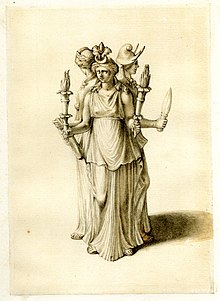
Hekate, Three Headed Goddess of the Crossroads. 
The one thing that struck me when Susan was talking was that she said that since the beginnings of Greek religion, Olympians vs. chthonian had always been the question, but I was blissfully unaware of this and hadn’t heard of the term until this course. If it is such a big question why is my knowledge lacking in this area? Jennifer Larson’s book for example devotes a whole TWO pages on the topic (!) A quick overview but then moving on to other (more important?) topics. Similarly Robert Parker’s book, the most recent one out of all the sources I am using only devotes four pages on the topic.

Another thing was when we did the exercise listing Olympian and chthonian gods I didn’t even think of putting any of the good which I think of as the big 12 in the chthonian list. To me the big 12 are like the superior gods who ‘deserve’ to live on mount Olympus because of how powerful they are rather than the type of power they have and so chthonian deities are inferior and lacking in power. Or another way I think I think of it is as a very Christianised binary of simply good vs. evil...

My list of chthonian deities included:
  •          Hades
  •          Persephone
  •          Gaia
  •          Rhea
  •          Prometheus
  •          Hecate
  •          Nyx
  •          Zeus katachthonians (added during discussion)


      But when we did discuss deities started to move but only in an Olympian to chthonian fashion. It seemed like the Olympians often had different sides to them but the chthonian were stuck in their places.
I’ve started to think about Greek religion through the concept of Christianity as I have to started to realise that I have quite a Christianised view of the world even though I would say I wasn’t a religious person. I’m more agnostic and haven’t had a strong Christian upbringing really. My main thoughts when thinking of the chthonian is that they were the ‘evil’ deities but that idea can’t have been there in ancient Greece? Surely it’s only my view of the world. The evil feeling grew stronger as Susan was telling us about how serpents were seen as chthonic because they were close to the ground and shed their skin, which is in keeping with the idea of life after death, but all I could think about was Adam and Eve and the serpent and once again the concept of evil was right in the front of my mind.
But where does the notion of evil really come from and can we say the Greeks had a concept of it? The gods themselves didn’t really seem to have any concept of morals. They are petty and the stories are full of parricide and incest – things which were a real taboo in Greek society. So could we maybe say the gods were there as beings one shouldn’t emulate, a guide in how not to act maybe? But were they evil? I wouldn’t say they were.

The deity I consider to be a classic chthonian is Hekate, maybe because I got introduced to her quite recently but she was never in my head as one of the ‘big 12’ Olympians and so her identity isn’t confused. According to Larson her role was to protect those travelling from dangerous spirits since she could control the restless dead (Larson  1997:166). She eventually became the ‘mistress of the crossroads’ and her name ‘Hekate Chthonia’ started to be used on lead curse tablets about the fourth century B.C.E. As she guarded the crossroads it meant she also guarded the graves along the roadside which was her link to the dead (Price and Kearns 2003:243). In this way and the fact she was the goddess of witchcraft, as seen in Medea, seems to link once again to Christianity and the persecution of witches – Salem witch trials for example for having powers beyond mortal means, not forgetting that she was also crowned with serpents and oak leaves. The serpent idea links back to the idea of original sin and the devil. So although she might have been seen as ‘evil’ in the moral sense she was “seen as simultaneously terrible and benign” (Price and Kearns 2003:243).

I like Hekate quite a lot actually. She seems to be an interesting figure, benign or evil. Maybe I should have concentrated on her, it is a shame I discovered the intricacies of her character so late in my blogging experience. It is too late to change now but maybe I can study her more in further studies. 

Bibliography
  •          Larson, Jennifer (2007) Ancient Greek Cults: A guide. Routledge. London & New York.
  •          Parker, Robert (2011) On Greek Religion. Cornwell University Press. Ithaca.
  •          Price, Simon and Kearns, Emily, eds. (2003) The Oxford Dictionary of Classical Myth & Religion. Oxford University Press. Oxford. 

Image
  •          http://upload.wikimedia.org/wikipedia/commons/thumb/2/2e/AN00969955_001_l.jpg/220px-AN00969955_001_l.jpg

Concluding Thoughts On My Blog.

Now for a few reflective comments on this project. This is my second time writing a blog for an assessment and I feel I have improved somewhat from last time. The formatting is better and I feel I have kept more focus, although less engagement with visual images and I believe this time around I'm slightly more reflective.

I am quite surprised by where my blog ended up. After spending so much time on my first post deciding which deity I'd use to think about the topics I completely bailed and used another religion instead. 
I was quite surprised to realise how much of my subconscious thoughts immediately went towards Christianity. 

Something I didn't do was reflect on any images, I was too busy concentrating on the actual content that I feel I forgot that it was even a possibility. For one of my posts I was originally going to reflect on visual representations of Leda and the Swan, but this changed when I looked back at the trail of Christianity I was leaving behind me. So I adapted the post accordingly but I feel this could reflect badly on my blog as a whole and so I have made and found images to go into each post although they are not well linked into the text as a whole which is a shame. Once again time management has not been my strong point.

Overall I have enjoyed writing this blog and all the things it has made me think about. It has done nothing to quell my interest in Greek religion, but merely fuelling my desire to know more.